Dungeon Crawl Classics #11 The Dragonfiend Pact By Chris Doyle
(16 page d20 adventure for 4-6 2nd level player characters)
Front Cover Artist: William McAusland
Interior Artists: Jason Edwards, Brad McDevitt
Cartographer: Jeremy Simmons
If you are planning on playing in this adventure STOP READING NOW! - You'll go blind and hair will grow on the back of your hands.
For the original $2 cover price this module was quite a bargain.
There are some good ideas included though the plot is poor and some of the concepts are flawed. One of the main problems is that by making the town described in the story so unique it limits the placement and usefulness of the adventure. There is just too much concept for the 16 pages being provided.
There is a struggle for leadership of the town. The idea behind this seems fairly muddled and implausible. A town with an elected mayor, though the mayor is part of some kind of aristocracy, and a magistrate who is a cleric, but one who turns to evil when he can't become mayor. And the mayor's young naive daughter who becomes mayor herself when the magistrate hires an assassin to kill the mayor. Then there is the magistrates plot to rob the town and use rats to smuggle the goods outside of the town. There is an evil pseudo-dragon who sways the magistrate to worship an evil god of trickery (he's the cleric btw), and finally a plan to have the town raided by a goblin tribe so he can kill the mayoress and become the towns hero. Blah... way too much. I think I saw this plot on an old Andy Griffith show with Don Knotts as the evil magistrate and the actor who played Ernest T. Bass as the Were-badger.
The adventure itself isn't bad. The use of the rats is intriguing, but a better reason for using them needs to be provided. I'm not sure just how much wealth could be smuggled out of a frontier town via rat-back. Might be handy for a city adventure with a jewel thief, or a mining town and someone smuggling out gold dust, but there really isn't much reason why the thief couldn't smuggle the valuables out by himself. Such things as what is being stolen and how are left to the DMs imagination, as well as particulars about the town.
The dungeon could have a small plot operation and be dropped into the Idylls of the Rat King adventure fairly nicely.
I wouldn't recommend this for a DM looking for a quick and easy adventure and the amount of work necessary to make it playable might as well be spent in adding it to an adventure with a better plot, or creating one. For the $2 it cost, it was still a bargain as an adventure aid. Semi-decent maps and some good ideas. It would have been better off without the attempt to make into something more.
CAS

Showing posts with label DCC. Show all posts
Showing posts with label DCC. Show all posts
Thursday, May 26, 2011

Tuesday, May 17, 2011
Review: Dungeon Crawl Classics #10 The Sunless Garden
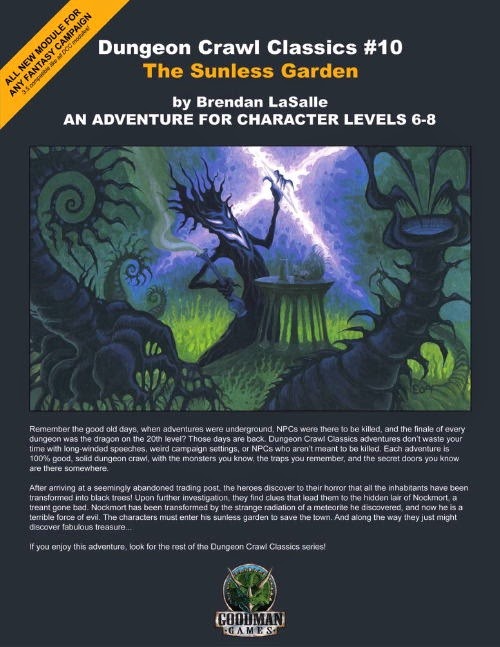
Dungeon Crawl Classics #10 The Sunless Garden By Brendan LaSalle
(A 32 page d20 adventure for 4 to 6 player characters levels 6-8)
Front Cover Artist: Erol Otus
Back Cover Artist: William McAusland
Inetrior Artists: Jason Edwards, William McAusland, Brad McDevitt
Cartographer: Jeremy Simmons
If you are planning on playing in this adventure then STOP READING NOW! Or I will be forced to summon Hastor, Hastor, Hast... oops...
There is a slightly lovecraftian feel to this module as well as a sprinkling of humor.
This is a vast adventure stuffed into 32 pages. Well written but missing a few elements. The Otus cover is fantastic, the balance favors the players but it seems challenging enough and interesting. I pick apart a number of elements in this module but this is a very good adventure that I feel could have been a truly great adventure.
The plot involves a Treant corrupted by a fallen meteor in a somewhat Color out of Space concept but with less dismal cancerous wasting and more mutations. It would involve a little work on the DMs part but this could easily be converted to a much darker adventure, the spots of silliness removed, such as exploding apple grenades, cavorting owlbears, and the invention of toothpaste and peanut butter, and replaced with more gruesome and perhaps lovecraftian touches.
LaSalle is an excellent descriptive writer and his concept is creative with many interesting touches for a garden/wilderness adventure but 32 pages just did not provide enough room to cover the size of the area he tries to describe. The interior map is bland, as are most of the DCC maps in the first 10 adventures in their line. The text makes note of the vast size of the map, 50 feet per square, or more accurately 2,500 square feet per square. Each section of this underground garden is huge, the ceiling high above, the center of the cavern accommodating trees of over 100 feet. Unfortunately LaSalle only has a few paragraphs to touch on each section. Each area has some detail, challenging, humorous, intriguing, but not enough for the ground being covered. I have no doubt that this adventure could have been incredible, instead of merely excellent and flawed, if it had been allowed to grow in description and detail to a fuller page count.
The main theme is a corrupted treant's war against despoiler races such as humans, (though for some reason it has no problem with bugbears who fill in the empty chambers within the former smugglers den it calls home that would otherwise need to be filled with something more creative). Why not a race of mutated bugbears, or plantmen, or a merging of the two? The use of the bugbears feels out of place in view of the plot of the adventure and so easily changed to a mutated form that it makes me feel that they were slapped on like a hastily blotted background to a detailed portrait thats creation has perhaps passed its deadline.
To combat humanity the treant has found a mutated growth which can be used as a poison. This poison turns humans and humanoids into trees. This substance, Black Moss, will potentially effect the players and I was expecting to find it detailed in the appendix section. A paragraph on page 3 titled Effects of the Black Moss were surprising in their lack of information about the effects of black moss. One paragraph describes that a check is needed when tasting infected water, but the next three paragraphs describe how it was made, the antidote, and effects of the antidote, and prevention. What is not described are the actual effects in game turns. How long does it take to be overcome, what happens to characters infected before they are turned into trees? What is the effect if it is inhaled? Do you only need to save once against it? Some of the information can be pieced out from other paragraphs in the adventure. It seems to take 3 days to be turned into a tree, and the character will be slowly petrified though there is no description of the actual process. In the end it will be up to the DM to actual work out the mechanics of this poison. A definite flaw in the modules design.
The adventure itself is straightforward. There are few allies to be found and little or no misdirection. The monsters and mutations are there to be killed or overcome. The wide undescribed sections of the garden could be filled with brief encounters of unsettling but non-hostile plant life or glossed over lightly, as the characters pass trees, bushes, or walk over grass or weeds till they come across the written encounters. The vastness of the garden could be shrunken and encounters combined into a single section rather than spread out over 6 or more areas hundreds of feet across. There is a great deal of room for expansion in this adventure, and even more as suggested at the end of the module, this may not be the only meteor.
A good adventure, even an excellent one, especially the concepts involved, but the execution is missing detail that would have made this a great adventure.
Friday, May 13, 2011
Review: Dungeon Crawl Classics #9 Dungeon Geomorphs

Dungeon Crawl Classics #9 Dungeon Geomorphs By Clayton Bunce
WARNING! THIS IS NOT AN ADVENTURE MODULE!
I had a vague notion of what I was getting when I picked this up. I just had no idea it would be quite as worthless and crappy as it turned out to be.
Back in the early days of D&D several geomorph supplements were released. They featured the graph paper style blank maps that adorned modules like B1 In Search of the Unknown. 25 or so years later Dungeon Crawl Classics released something exactly like those early geomorphs but of slightly lesser quality.
These are for those players who have no access to the internet where they could download maps or graph paper and a pencil for them to draw their own. Every time I pick this supplement up I am astounded at its uselessness.
If you see this in a module lot offered for sale somewhere consider it a waste of shipping cost.
Sunday, May 8, 2011
Review: Dungeon Crawl Classics #8 Mysteries of the Drow

Dungeon Crawl Classics #8 Mysteries of the Drow By Jeff Quinn - Poetry by Susie Quinn
(48 page d20 adventure for 4-6 player characters levels 7 to 9)
Front Cover Artist: Erol Otus
Back Cover Artist: William McAusland
Interior Artists: Jason Edwards, Carlos Henry, Brad McDevitt
Cartographer: Jeremy Simmons
If you are planning on playing in this adventure STOP READING NOW! - or I will have to hurt ya.
I won't lie to you, some parts of this adventure will get your characters killed, but who those characters are is one of several problems with this module. This was a tournament adventure and it has not been reworked so as to easily fit into an ongoing campaign.
This is a drow adventure from a drow's point of view. I could see where it could be used to flesh out an underdark campaign against the drow, but converting to AD&D and making it fit into a campaign will require some work. It is a good adventure and worth the effort in my opinion.
As designed the pre-rolled player characters are drow or drow allies (I have no idea what a Shur or an Urbam might be but they are listed as two of the characters races). It is suggested that two accessory products be consulted, the Goodman Games Guide to the Drow and Aerial Adventure Guide not own either of them and can't offer an opinion except to say that they do not appear necessary to play or convert this adventure.
The adventure lacks a great deal of detail to run it within a campaign. Since it takes place in the underdark it cannot easily be used outside of such a setting. Altering it to AD&D will demand the conversion of several spells and devices as well as a decision on whether or not to allow versions of firearms into a campaign.
This can be a deadly adventure. Some of the encounters may need toning down regardless of the edition used, though a DM may decide that powerful monsters or NPCs will force the players to tread carefully, seek alliances or simply run away from time to time.
Unfortunately this isn't a pick up and play module unless run as a tournament with drow player characters. For use as a campaign adventure the general area of the underdark will need to be detailed. The background will need to be altered as well. I'm old fashioned and don't run campaigns with evil player characters, and have never used drow as anything except evil NPCs. My conversion of this adventure is to use players descending into the underdark, fighting drow, and perhaps gaining allies among the good NPC races opposed to the drow. The adventure works perfectly well with this style of play. Even the pre-rolled player characters can add another element to the adventure. Following the background of the tournament these drow can be another encounter, perhaps a recurring enemy group the players must fight and hopefully defeat.
As mentioned there are some new spells and devices in this scenario. I liked them. There is also an exceptionally good idea for a puzzle lock and a player handout, and no one should be surprised that I thought the Erol Otus cover art was fantastic.
Not a pick up and play adventure by any means, but some very good ideas and encounters. I recommend it to anyone running an Underdark campaign, but a DM should be prepared to put some work into it before use.
Saturday, May 7, 2011
Review: Dungeon Module F1 The Fane of Poisoned Prophecies

Dungeon Module F1 The Fane of Poisoned Prophecies By Guy Fullerton
(24 page AD&D adventure for 5 to 7 player characters levels 4 to 6)
Front Cover Artist: Peter Mullen
Back Cover Artist: Jason Braun
Interior Artists: Jason Braun, Andy "ATOM" Taylor
Cartography: Guy Fullerton
If you are planning on playing in this adventure STOP READING NOW! - The rest of this review has been booby-trapped
This adventure was more than a pleasant surprise. Excellent maps, nice artwork that actually shows places and events taking place in the adventure, and an intriguing scenario that needs no alteration or conversion. A DM should be able to read through and run this module with no problem.
I have sampled the later editions of Dungeons & Dragons and have no taste for them. Finding an actual AD&D adventure is a treasure, but this particular adventure is a real gem. It is almost entirely well balanced and challenging. The background is interesting, the level of detail amazing, and the possibilities are great for further adventures either created by the DM or hopefully from Chaotic Henchmen Productions.
I loved the almost-Otus cover art and the fact that the outer cover was not stapled to the interior booklet. A wilderness map is provided, and detail maps of several small buildings surrounding the central location itself. There is a cut-away view of the main building and a drawing of it seen from the outside (The same illustration on the back of the cover as on the front of the booklet. It would have been nice to have an extra illustration).
The adventure starts out at a slow pace with some encounters that should be combat and some that provide detail, background and clues. There is one encounter with an extremely powerful guardian that could easily slaughter the party and, to me, the chance that this encounter could get out of hand is too great. A trap, a tomb and an 18HD iron golem. I would provide a more detailed warning than a single corpse as well as giving the players a greater chance to withdraw. I'd hate to have an evening's game with established player characters come to a sudden end because a side encounter was far too lethal. Easily altered or toned down. Nice illustration though.
The central building and the core of the adventure is a nice mix of traps and monsters. My personal preference would be for greater and more varied types of combatants and probably a darker theme to the plot. But this is a nice straightforward adventure that has room for many possible additions from a creative DM. It is also a pick up and play adventure and includes a full set of pre-generated characters. If not used by the players the DM could add them to the scenario as NPC competition or even possible allies for the player characters.
While this adventure is only 24 pages the print is very small as are the margins. There is a great deal packed into the module and I'd equate these 24 pages with at least 40 pages of material from other publishers.
Anyone running an AD&D campaign and looking for published adventures should snatch this one up and keep an eye out for the sequel.
Friday, May 6, 2011
Review: Dungeon Crawl Classics #7 The Secret of Smuggler's Cove

Dungeon Crawl Classics #7 The Secret of Smuggler's Cove By Chris Doyle
(40 Pages, d20 3.5 compatable adventure for 4-6 player characters levels 5 to 7)
Front Cover Artist: Chuck Whelon
Back Cover Artist: William mcAusland
Interior Artists: Jason Edwards, William McAusland, Brad McDevitt
Cartography: Jeremy Simmons
If you plan on playing in the adventure STOP READING NOW! - Or I will have to set my Dalak's after you - EXTERMINATE! EXTERMINATE! EXTERMINATE!
This adventure seems like an homage to the old AD&D U1-3 Saltmarsh series, though I don't see that mentioned. Many of the basic plot elements are the same but if I had to choose between the two I'd probably pick this adventure. The saltmarsh series were introductory and low level adventures while DCC#7 starts off at mid-range experience level for the PCs allowing more diverse and powerful challenges.
The module provides a map and background material for the town where the PCs will be based, sufficient if slightly uninspired plot hooks to bring the characters into the adventure and an interesting background for the dungeon, its previous and current occupants.
As with the U series the first area to be explored is fairly vacant and not meant as a serious challenge to the party. Unfortunately several of the early encounters threaten to reveal the entire secret of this adventure, far too soon in my opinion. It is entirely possible for the players to explore the lighthouse, the manor, and the 1st dungeon level beneath without discovering the caves housing the smugglers or their allies.
It would be a shame to reveal the entire secret too soon since the scenario is filled with possibilities for misdirection. Despite the name of the adventure the townspeople are unaware of the smugglers presence or the danger they face from the aquatic tribe nearby. The tower is merely haunted, the manor house abandoned and become the abode of vermin and monsters and the evil temple beneath it unsuspected. My feeling is that the smugglers should be hinted at rather than revealed and the locathah left as a surprise till they are encountered. This requires several alterations in the written encounters.
1. The ghost of the lighthouse keeper would, I feel, be much better served as a clue or even potential ally, rather than a difficult combat encounter. If he had died not knowing who killed him but seeking some item of his that the smugglers might have looted then he could appear again at a convenient time, distracting an enemy, providing guidance or even atmosphere to the adventure. He is likely to be destroyed without revealing any information, or if the ability to question him exists, he is even more likely to reveal too much, too soon.
2. Inside the manor the PCs will encounter a small group of gnolls. Here is a danger of revealing all to the players. The smugglers, the locathah and the plans of the locathah unknown even to the smugglers. I also question why written contracts would exist between gnolls and locathah. The concept seems out of place in any fantasy world. Instead I would have the gnolls kept in the dark completely about the locathah and some type of misdirection applied. Invited by an evil mage or cleric, or a bandit gang, anything to keep the players from suspecting smugglers.
3. The harpy. As with the gnolls the harpy would be of better use to the smugglers as a cover for their own activities. She may know or suspect more, that they use the dungeons beneath the manor, but why reveal to her that they are smugglers. The players may begin to suspect that the secret of smugglers cove is that there are no smugglers only bandits or an evil cult instead.
4. Below the manor the 1st level of the dungeon is mostly abandoned. The temple itself is still defended but for the most part there is little to encounter. What fails to make sense to me are the prison cells. The players cannot help but find them if they explore the manor and the prisoners know far too much to be left so exposed to a casual search by the strong party of adventurers. Why would prisoners be kept at this dungeon level and not deeper within the smugglers cave? The bard is needed for the smugglers to make use of the lighthouse and he is aware of much of what has been going on. My suggestion is to remove the bard and place a smuggler as a captive, perhaps more than one. The smuggler could pose as a traveling merchant or mercenary guard who tells a story of bandits or evil cultists. The local farmer could also have been lead to believe this tale and set the players off against a tribe of gnolls or scouring the nearby roads or wilderness for bandits, perhaps with the smuggler volunteering to accompany them as a henchman or a guide, or offering a reward for valuable merchandise taken. The ogre more appropriate as an unwitting hireling openly guarding the prisoners and another smuggler guarding the secret entranceway. One that would not run out and reveal the passage down to the smugglers hideout.
My feeling is that adventure would be better by trying to set the players on the wrong path rather than revealing so many secrets at the start.
The rest of the adventure is enjoyable but heavily combat oriented. Once the players are aware of the smugglers and then encounter the locathah the adventure becomes a challenge of arms with the players struggling to defeat the smugglers and their allies. The DM may have the smugglers choose to run at some point, but the locathah are less likely to flee especially before its leaders are killed.
All in all an excellent adventure. Adding some misdirection for the players could make this into a small campaign while the adventure itself should provide more than one session of gaming with several areas to explore and challenging encounters. It should be an easy conversion to AD&D.
Wednesday, May 4, 2011
Review: Dungeon Crawl Classics #6 Temple of the Dragon Cult

Dungeon Crawl Classics #6 Temple of the Dragon Cult By John Seavey
(32 page d20 adventure for 4-6 players levels 8-10)
Front Cover Artist: William McAusland
Back Cover Artist: Brad McDevitt
Interior Artists: Jason Edwards, William McAusland, Brian Rasis
Cartographer: Jeremy Simmons
If you are planning on playing in this adventure STOP READING NOW! - You'll shoot your eye out kid.
This adventure is a hammer and a DM can use it to smack around a group of players to his heart's content. It is straightforward but not simple or boring. It manages to be very challenging without being ridiculously lethal. The worst thing about it are the maps.
I will jump to the maps first. The scenario covers the inside of a mountain, once a dwarven settlement, but the maps are just circles and corridors. I would have liked to see some worked passageways and rooms, something with more detail and character. This is just a minor complaint and it does not effect the adventure. But there is more. There is an attempt to add some complexity to the adventure by having multiple connections to the other dungeon floors. This works in well with the scenario, but the maps add a touch of confusion with the branching corridors and small isolated segments on each level.
The plot is reasonable if not inspired. The adventure itself is well balanced. Some areas are easy, others challenging, the final encounter a true challenge. There are traps to find, some story elements to discover, and tricky combat encounters throughout.
The heart of this module are the combat encounters. The nature of the storyline makes that unsurprising. This isn't about a rescue, or a treasure hunt, though treasure can be the main motivation, and it isn't about exploration, or some other worldly evil. The players are going after a dragon in its lair to kill it.
There are a number of traps, but most are so simple, falling into pit traps covered by tarps or illusions, that at most they would slow a party of 8th to 10th level characters down rather than be any kind of threat. That works out fine because this isn't a dungeon crawl it's a combat operation.
Most of the encounters should go the players way without much difficulty. The party should out-number or out-power the first few defenders or even pass them by. There are two places before the final battle that should challenge the party , but any areas bypassed, any combatants not dealt with in a particular area can be used by the DM to act as reinforcements for encounters nearby.
Converting this adventure should be no problem. There are rules for a new spell and new type of monster creation designed for d20 but the concept works fine with the AD&D rule system. Each encounter simply needs to be beefed up or toned down and some of the tactics reworked for AD&D characters.
This adventure can be stretched out simply by adding another level to the map complex or a way for the defenders to be reinforced if the players make multiple forays into the mountain instead of a single drive to the final encounter.
Temple of the Dragon Cult is one of the best and most balanced adventures I've come across in the DCC line. It plays well as written but can easily be expanded or used in a larger campaign.
Wednesday, April 13, 2011
Review: Dungeon Crawl Classics #5 Aerie of the Crow God / #5.5 Seed of Evil

Dungeon Crawl Classics #5 Aerie of the Crow God / #5.5 Seed of Evil By Andrew Hind
{64 Page d20 adventure for 4-6 players levels 7-8 (DCC#5) 4 players level 9 (DCC#5.5)}
DCC#5
Front Cover Artist: Chuck Whelon
Back Cover Artist: Brad McDevitt
Interior Artists: Jason Edwards, Brad McDevitt, Stefan Poag, Brian Tarsis
Cartographer: Jeremy Simmons
If you are planning on playing in these adventures STOP READING NOW! - I really mean it this time.
The edition I reviewed contains the adventure DCC#5 and the sequel DCC#5.5. It struck me as odd that they have different recommendations for the size of the party. I noticed one map error on page 63 of this edition that refers you back to page #48 for an overhead map of level A encounters (it is now on page #64).
The are some excellent ideas and interesting maps in this double adventure. It will require a bit of conversion work to recraft it for AD&D mainly due to the nature of higher level d20 rules drifting further from their AD&D origins. The main problem I found was that these adventures are remarkably underpowered.
DCC#5 begins a bit strangely. The plot device to get the players involved in the adventure feels unlikely and somewhat strained, even more so because it was intentionally left undeveloped. This plot can be used or another motivation put in its place with little difficulty but it struck me as more awkward than useful. I made many alterations in this module when I converted it to AD&D and abandoned the central plot motivation. This removed the time constraints ( a 3 day deadline to find a missing key) and made it into a campaign rather than what might be a single session game for the DCC#5 portion (although it would have to be a lengthy day's gaming since DCC#5 covers a good number of rooms and encounters unaltered).
The six pages of background and DM charts and recommendations are quite helpful. I have always found the Game Master's Section encounter table at the start of DCC adventures to be a wonderful inclusion. From here it is a short step directly to the dungeon.
Once started the adventure offers surprisingly little risk for the rewards. A small group of 2HD monsters defending over 1000 gold in coin. A telepathic sword that can sever hands on a critical hit left lying outside the entrance to the tower. The tower itself almost empty (13 rooms with three combat encounters, only one of which offers any actual challenge to the players). It is a shame because there are good ideas here and interesting encounters, but not enough of them and not enough meat for the players to dig into.
From the tower the quest will lead to an underground temple. Some undead guardians that a cleric should have no trouble turning or the party hacking into little bits.
Once in the temple area the players may choose one path that will lead them to the key they were looking for, and end the timed portion of the quest (if they were following that plot line), or another passage that will lead them to an abandoned shrine of Matlock... I mean Malotoch. (Except that every time I see that name I keep hearing Grandpa Simpson calling out Matttt-Lock from an early sideshow Bob episode).
The 2nd and 3rd levels of the temple are an excellent dungeon crawl but really geared more for characters two levels lower than the ones recommended.
Without much alteration the entire temple area would make a fine 5th or 6th level adventure. The other named weapons are powerful but not absurdly so. The gold values can be toned down (especially if they also are being used to compute experience). The same goes for the treasure awarded. Most of the monsters run between 5 and 7 HD including the bosses.
The adventure ends with a nice enjoyable battle in an evil temple with some good suggestions for further adventures.
Dungeon Crawl Classic #5.5 Seed of Evil is only loosely connected to the Aerie of the Crow God. Once again the players are fighting the evil God malotoch in a short wilderness/dungeon trek. It is a nice little adventure with possibilities, but with only a handful of rooms and encounters with nothing particularly outstanding.
Strangely this is recommended for only 4 players, which makes it hard to mesh directly with DCC#5 if that group consisted of 6 players, but even 4 ninth level players will have an easy time up until the final encounter with Malotoch herself. Like DCC#5, DCC#5.5 would be more challenging and better suited to a party of 5th or 6th level characters.
There is room in Seed of Evil for a better adventure to grow. The encounter with a God is too heavy handed for my taste. The players are not meant to be able to defeat Molotoch so the entire encounter becomes plot device. The confrontation seems pointless. Simply running afoul of Molotoch's clerics and followers should be enough to create a recurring nemesis for the players if the DM so desires.
The back of the module contains a map of the town Carnelloe which is near to the tower and temple with a few NPC blurbs of town residents, a listing of new monsters and magic items, and some player handouts which are mostly illustrations of various areas in the adventure (something I've always enjoyed ever since they first started providing them in TSR modules like S1 Tomb of Horrors).
This is a good all around adventure. I don't see it as difficult to convert to AD&D, but I do recommend adding more encounters to the first areas, and either beefing up the entire adventure to suit 7th or 8th level PCs or trying it with a lower level group.
Tuesday, April 12, 2011
Review: Dungeon Crawl Classics #4 Bloody Jack's Gold

Dungeon Crawl Classics #4 Bloody Jack's Gold By Joe Crow
(A 32 page d20 adventure for 4-6 players levels 10-12)
Front Cover Artist: Erol Otus
Back Cover Artist: Chuck Whelon
Interior Artists: Brad McDevitt, Chuck Whelon
Cartographer: Jeremy Simmons
If you are planning on playing in this adventure STOP READING NOW! - You Have Been Warned.
Here is the first great parting of the ways between the DCC line and AD&D. It was inevitable that d20 adventures would draw more upon the options and alterations of third edition as the level of the adventures became higher.
My reviews are centered around the aspects of these modules that either need no conversion to AD&D or how they would relate to an AD&D adventure of equivalent level. I will not be focusing on them in terms of their third edition usefulness or playability.
The Otus cover art is fantastic. The scenario is filled with good ideas but the maps are a little sparse. I believe that the adventure itself is underpowered for twelfth level characters ( and this is something I see for either AD&D or 3rd edition).
I enjoy a good treasure hunt and I have always found pirates fun as a basis for adventure. Dead pirates especially so. The concept is intriguing. Even a successful expedition against the island and the treasure shouldn't keep it from being restocked to be used again. The plot is ripe for expansion but there is nothing to keep a DM from running it as is with few necessary conversions(though I recommend beefing it up in many ways if twelfth level characters are going to be used).
The map of the island and the monastery could not be simpler, and in that respect I find them extremely disappointing. The wandering monsters and set wilderness encounters, such as the fiendish sharks, are doomed. Any high level magic-user or druid has too many options for destroying or circumventing them just in their spellbook arsenal. What items or devices the players will also have at their disposal at the very start of this adventure should have no problem eliminating 8HD monsters with no magical abilities or ranged attacks. The problems with underwater combat are mentioned, but any experienced adventuring group going on an adventure in the middle of the ocean will be prepared.
It might be better to toss the players on the island as a shipwrecked group rather than give them a prepared base of operations. The scenario suggests that any ship will be manned by low level NPCs incapable of defending themselves against the more powerful monsters that can be thrown at them. While this may be true it would be something a prepared adventuring group would think of. Defending a base camp has always been a problem, but for characters this powerful would they even arrive by ship? The players are either going to have a secure base or be on their own and experienced players are going to know this. At twelfth level the PCs are going to have henchman, followers, companions, hirelings, if they are coming as a prepared expedition. This has always been the problem with high level games; the amount of resources available to the characters and the gaming experience that the players themselves have to call upon.
In this respect the adventure as-is doesn't offer much of a solution. The resources in terms of monsters the DM has to call upon as written are fairly inadequate. But it does offer up a number of possibilities for a DM to add to the scenario and even unsuccessful attacks against the PCs base or ship should be interesting to play and a drain and disruption on the treasure hunt. I'd recommend planning a series of attacks and events upon any ship or base camp that the PCs leave behind. Attacks in greater number, perhaps increasing over time, and planned events such as storms, sickness, ship sightings, than are mentioned in the adventure itself.
Now part of the plot includes an Imp spy who keeps a watch on the adventurers and seeks to tempt them to sell their souls in exchange for aid or perhaps survival. This seems so far fetched and unlikely, as well as creating an index-card exchange between DM and player, that I was sad to see it included. The party should be perfectly able to keep a watch for invisible creatures and the likelihood of any player being fooled into signing away their soul seems minuscule. For me I thought it was a bad idea and a waste of text, but perhaps other DMs can make use of it.
As I mentioned the island is undetailed. There is a suggestion in the text that the jungle is so dense as to be impassable except along an overgrown pathway. This is the green dungeon syndrome, where the forest is nothing but dungeon walls and the pathways and roads dungeon corridors. Wilderness adventuring tends to provide choices in a full 360 degrees as well as 3 dimensions. Railroading players down a set path in what should be an area of plentiful choices has never been a recipe for a fun adventure in my experience. But having an actual wilderness on the island will force the DM to create it themselves as it is not provided for in the module.
The adventure doesn't begin till page six. There is an overflow of superfluous information and background that really should have been devoted to the adventure itself. Greater detail and encounters on the island would have, I feel, been a much better use of ink and paper.
Finally the treasure hunt begins. This is a very combat oriented adventure rather than a tricks and traps scenario. For me the concept works very well. The adventure isn't about hidden treasure, though the players need to believe it is. It is about assembling a small army of undead. Unfortunately the types of undead encountered are far too low level for the recommended power levels of the party. A twelfth level cleric is going destroy any skeletons, zombies, wights and shadows lined up against them. Mages will use area effect spells from a distance on the same and a score of zombies or skeletons that are fireballed are simply going to so much charred rubble under the players' feet. How many 1 HD skeletons and 2 HD zombies would it take to kill a twelfth level fighter? I am not an expert in third edition but the bulk of the monsters in this adventure just don't seem up to the job.
But despite everything I have objected to I have to say that this is a good adventure. Converting it to AD&D should be no problem and either beefing up the encounters or lowering the recommended level of the module (while also lowering the level of some of the more powerful monsters) should be easy.
The heart of this adventure is very sound. The possibilities for expanding the adventure are many. As is, though, I believe it will too easy for a group of twelfth level characters.
Monday, April 11, 2011
Review: Dungeon Crawl Classics #3 The Mysterious Tower

Dungeon Crawl Classics #3 The Mysterious Tower By Joseph Goodman
(A d20 Adventure for 4-6 Players Levels 3-5)
Front Cover Artist: Erol Otus
Back Cover Artists: Brad McDevitt
Interior Artists: Brad McDevitt, Marks Parsons
Cartographer: Jeremy Simmons
If you are planning on playing in this adventure, STOP READING NOW! - Spoilers - like there is no Santa or Angelina Jolie is really a man - I told you to stop reading
What a fantastic piece of cover art by Erol Otus... I should stop writing now....
The best thing about this module is the cover. This isn't a terrible adventure just a ho-hum bit of monster killing that makes little sense. A kind of low level poor man's Tomb of Horrors like one of those state fair miniature portable roller coasters but without the strung-out ex-cons at the controls, and with less rust and beer cans.
The premise of the module is painful. A wizard puts the magical on/off switch for his tower's permanent wall of force just a few inches outside his tower while he is inside his tower turning it on for the first time. Trapped inside he goes insane, dies and becomes that wickedly cool looking Otus-drawn ghost on the cover but doesn't really have much of a part in the bulk of the adventure. What a waste.
Getting to the on/off switch is the main focus of the module. The ground level portion is a brief scare by the ghost and the extermination of some vermin, literally. Absolutely nothing surprising or challenging and the greatest danger seems to be falling into a sinkhole. The exterior map is plain and uninspired.
The first level below ground has a small but interesting map. The encounters are split between a nest of owlbears with a dab of pathos and a small tomb with a bit of silliness and one of the most annoying undead, a wight. I hate level draining. This is an important level and depending on how obvious or easy the DM wants to make it the players will need to do some searching here. That shouldn't be a big problem, only, perhaps, time consuming. Again; the challenges on this level are minimal.
The next level down is very short. Three numbered areas, large spaces, but really just one combat encounter after another. It should be possible for a thinking party to defeat each monster easily or a non-thinking party to fight their way through.
The third level down is the tricks and traps section. To me these traps seemed uninspired and easily circumvented. An incautious and inexperienced group of players could get themselves killed but it would be like drowning in a bathtub and after the first time it is unlikely that the players would let it happen again, and again. A little caution if not experience with traps will get the players through this area, and that is basically that.
The tower itself is pretty much reward without many risks and an "all martians are liars" type of puzzle.
All in all I found this adventure to be low on challenge but one that can easily be tossed into the middle, start or end of a campaign. A one-shot scenario that could be spiced up with some effort by the DM or played as written. The Otus cover immediately made me think 'classic' and the module itself made me think 'forgettable'. Very handy for a pick-up game or a filler for a rushed DM.
Review: Dungeon Crawl Classics #2 The Lost Vault of Tsathzar Rho

Dungeon Crawl Classics #2 The Lost Vault of Tsathzar Rho By Michael Mearls
For 4-6 D20 Level 1 Player Characters
Front Cover Artist: Jim Holloway
Back Cover Artist: Brad McDevitt
Interior Artists: Friedrich Haas, Brad McDevitt, Marks Parsons
Cartographer: Matt Snyder
If you are planning on playing in this adventure STOP READING NOW! - This is your only warning.
This isn't a first level adventure. It really, really isn't.
This is not an adventure for an inexperienced DM either. There are a number of balls that come into play past the 1st level of this dungeon crawl and they will have a DM quiet busy keeping them in the air if used as written.
I have a problem with adventures where first level characters are supposed to save the world. It just doesn't make sense to me so I have a very hard time relating the overall plot to a first level adventure. In many ways it reminds me of the much higher level TSR adventure WG4 Forgotten Temple of Tharizdun with a tiny hint of Judges Guild's Dark Tower. But the plot itself is not much of a problem and even elder outer gods from beyond this dimension need to start somewhere so I am just being picky.
The problems I have start immediately. The players arrive in the frontier hamlet of Hadler's Gap. There is no map of the town or area around the town and adventure. DMs are encouraged to develop Hadler's Gap or use the village from other DCC adventures. One small paragraph provides all the details of the players base of operations that the DM is going to get. There are a few adventure hooks provided, but this is not a pick up and play module by any means. Instead a page and a half is devoted to text describing the rather grandiose background of Tsathzar Rho and the Outer Gods and a large half-page illustration that seems to depict nothing the players are going to encounter in this dungeon, and a blank area lacking text or illustration that could have been used for village map or some description.
The players immediately encounter an insane 4HD ogre, this could be a very brief adventure for the group especially since one of the adventure hooks has the players taking refuge from a storm inside the ogre's cave. Roll up characters, fight battle with monster that can kill the characters with one shot, then roll up more characters. The rest of the 1st dungeon level offers nothing as challenging or instantly lethal. The most potentially unbalancing item is an item that may be worth 1000 to 2000 gold. A lot to hand out to first level characters but perhaps a way to force level advancement. Easy to remove or even reward at a later date, but a bit of a campaign monkey wrench for an inexperienced DM to handle.
It is the dungeons 2nd and 3rd levels that are my greater concerns.
A side note here about the maps. I have the 2nd printing of this module. The maps show some character and remind me of old TSR maps that might have graced the inside cover of the D series. Unfortunately my printing has the level 2 and 3 maps mislabeled. Nothing that causes more than a moments confusion but I am surprised it wasn't caught during playtesting.
The player characters enter the 2nd level and encounter a 4HD monster... wait, this has happened before, only this 4HD monster can both web and poison the PCs as well. I suspect that by the 2nd level of the dungeon the PCs are meant to be second level themselves. With AD&D rules I am not sure how they this would be managed but I am doubtful that even 3e rules would prepare raise them high enough at this point. This isn't merely a monster with more HP, this is a monster with much greater abilities. This is damaging poison so the monster's attacks are more deadly, and the ability to web players effectively removes them from the combat. Played fairly, without plot device or dumbing down the monster, I can't see four to six first level PCs all surviving this encounter. Push them to second level and this is still an instantly lethal situation.
Once past this first monster there is a side excursion, two ghouls which individually should challenge the party, and a 4d12 HD ghast, which should probably slaughter the party.
From this point on things only get worse for the PCs. Kobold snipers while the PCs try to cross 100+ feet of water, elite kobold troops (I blame Tucker and that old Dragon article), and in large numbers. Eight kobolds versus six players, not a problem, but the next batch of twelve kobolds split between a pinning element and crossbows should prove exceptionally deadly. There is a single approach and no apparent cover.
And past this point the headache for the DM truly begins (the strange effect of the vault crossing from the pages of the module to the DMs dining room). Each hour of game time each player must save to keep themselves from falling under the strange effects or be affected by the effects resonating effectiveness. Once they fail their saving throws the results are going to be a monumental task of index cards and flavor text, hallucinatory battles and back tracking. The adventure talks about nightmares for the players on the 3rd level, but for the DM they have already begun and for the rest of this adventure they are now, "in effect."
Wait, isn't this supposed to be a first level adventure? Ghouls, ghasts, Tucker's Fallschirmjager kobolds and now Fear and Loathing in the Lost Vault of Tsathzar Rho. Each combat encounter from here on in seems to be another combined arms squad of kobolds. Two more twelve kobold units, and two smaller groups with officer types this time. The PCs could use a few grenades, light machine guns and some meds to help with the hallucinations.
Unfortunately the 3rd level is more of the same but with only one twelve kobold death squad present. The final encounter is fairly impossible.
I find this to be a greatly imbalanced adventure but not a terrible one. It isn't for an inexperienced DM or group of players and I cannot see how to run it for first level players. It needs work. Many of the cumbersome mechanics for the vault's strange effects need to be tuned to match the DMs style of play. The characters will need a base of operations. The town needs detailing. I can't see how to easily lower the challenges to make this first level, but many will need to be beefed up to challenge a higher level party.
This adventure is a major fix-er-up-er. Good ideas, good possibilities for expansion, but not something I would want to run as-is for the level recommended.
Subscribe to:
Posts (Atom)